

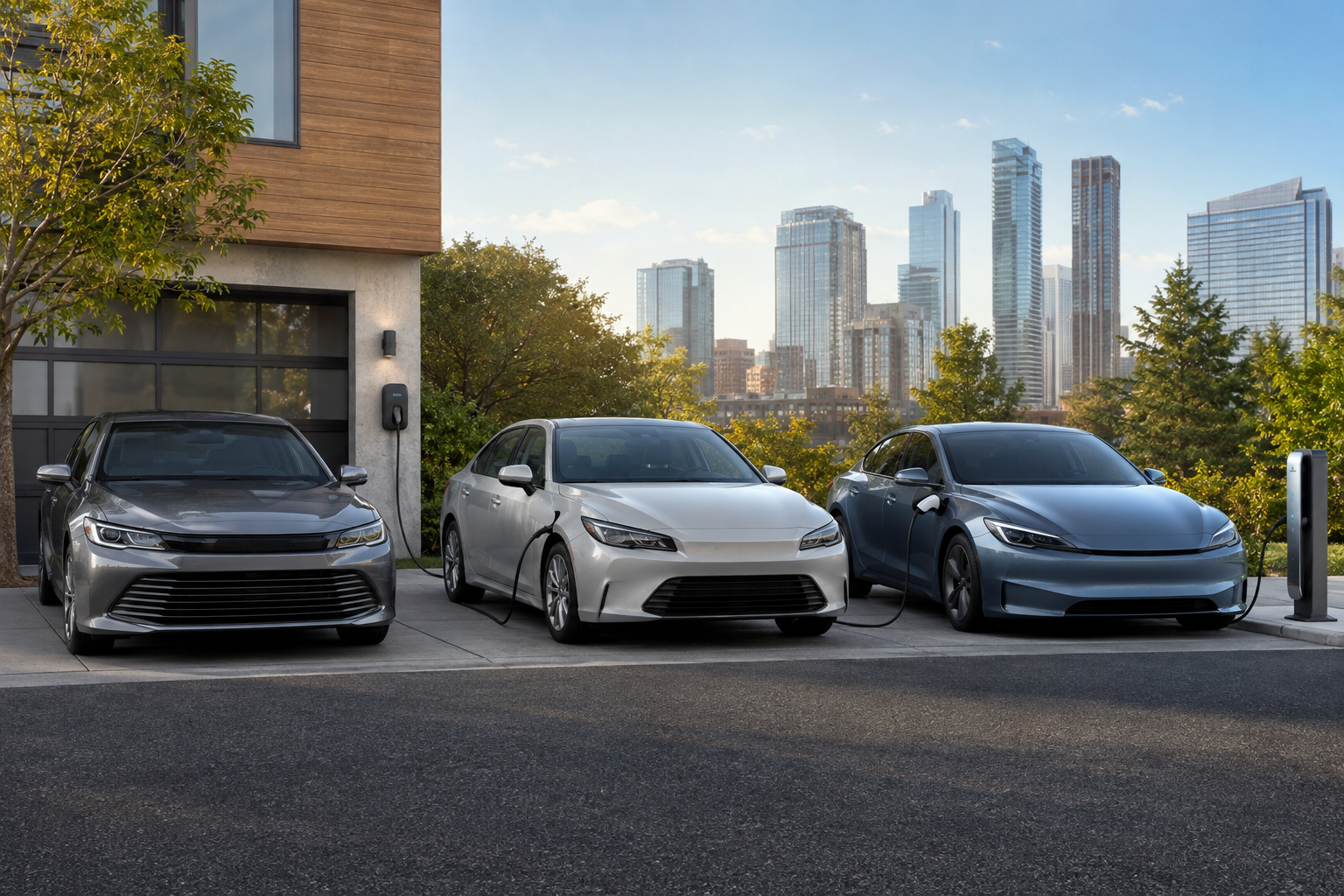
There is no universal "best" electrified vehicle. The better question is what kind of driving you actually do on an ordinary day, and whether your parking, charging access, and travel patterns align with the strengths and limitations of each technology.
A conventional hybrid changes very little about the routine: you fuel it normally and the system manages the electric assistance. A plug-in hybrid becomes more compelling when charging is convenient and daily trips fit its electric capability. An EV asks for the most deliberate charging plan, but it may fit beautifully when home charging and regular driving patterns line up.
Before shopping by category, think through your actual ownership situation.
Hybrid (HEV)
A conventional hybrid pairs a gasoline engine with an electric motor and a small battery. The system manages the electric assistance automatically - you do not plug it in and you do not switch between modes.
How it works:- The electric motor assists the engine during acceleration, deceleration, and low-speed driving.
- The battery charges through regenerative braking and the engine - no external charging required.
- Fuel economy improves compared to a conventional gasoline vehicle, particularly in stop-and-go driving.
- You want better fuel economy without changing your parking or charging routine.
- You do not have access to home or workplace charging.
- You drive a mix of city and highway miles.
- You want the simplest ownership experience among electrified options.
- Fuel economy gains are most noticeable in city driving. Highway fuel economy may not differ as dramatically from a conventional vehicle.
- Battery size is small, so electric-only driving is limited to brief low-speed situations.
- The system manages itself - there are no modes to select or charging decisions to make.
Plug-In Hybrid (PHEV)
A plug-in hybrid has a larger battery than a conventional hybrid and can be charged from an external source. It can drive a limited distance on electric power alone before the gasoline engine takes over.
How it works:- Charge the battery by plugging into a standard outlet or a Level 2 charger.
- Drive a limited range on electric power - typically 20 to 50 miles depending on the model.
- When the battery is depleted, the vehicle operates like a conventional hybrid.
- Some models offer selectable drive modes (electric, hybrid, sport).
- You can charge at home or work and your daily trips fall within the vehicle's electric range.
- You want to reduce gasoline use for short commutes but need the gasoline engine for longer trips.
- You have a predictable daily driving pattern (commute, errands, return home).
- If you cannot charge regularly, a PHEV operates as a heavier, less fuel-efficient hybrid. The battery weight reduces fuel economy when not charged.
- Ask about charging speed. Some PHEVs charge slowly on a standard outlet, which may not suit your schedule.
- Electric range varies significantly by model, temperature, and driving style. The EPA rating is a benchmark, not a guarantee.
- Check the battery warranty terms in the owner documentation. PHEV battery replacements can be expensive outside of warranty coverage.
Battery Electric Vehicle (BEV)
A battery electric vehicle runs entirely on electricity. There is no gasoline engine. The vehicle is charged from an external source and the range depends on battery capacity, driving conditions, and climate.
How it works:- Charge the battery using a home charger (Level 2) or public DC fast chargers.
- Range varies by model - most current EVs offer 200 to 350 miles per charge under favorable conditions.
- Regenerative braking recovers energy during deceleration.
- No oil changes, transmission fluid, or exhaust system maintenance.
- You have reliable home charging (garage or dedicated parking with electrical access).
- Your daily driving falls well within the vehicle's rated range.
- You have access to fast charging for longer trips, or your travel patterns do not require frequent long-distance driving.
- You are comfortable planning charging stops for road trips.
- Cold weather reduces range, sometimes significantly. Plan for 20 to 30 percent less range in winter conditions.
- Home charging is the simplest day-to-day solution. If you cannot charge at home, public charging may be your only option - which is less convenient and potentially more expensive.
- Fast-charging speeds vary by vehicle and charger. Not all EVs charge at the same rate, and not all public chargers deliver maximum power.
- Battery replacement outside of warranty can be expensive. Review the battery warranty terms before purchasing.
- Resale values for EVs are still evolving and may differ from gasoline or hybrid vehicles.
What to Compare Before Deciding
Before choosing a category, evaluate these factors for your specific situation:
- Parking and charging access. Can you charge at home or work? Do you have a garage, driveway, or dedicated parking spot with electrical access?
- Daily driving distance. How many miles do you drive on a typical day? Does that distance fall within the electric range of a PHEV or EV?
- Weekend and long-distance travel. How often do you drive beyond your daily range? Do you have access to fast charging for road trips?
- Climate. Cold weather affects battery performance in all electrified vehicles. If you live in a cold climate, consider how winter conditions affect range and charging speed.
- Specific model specifications. The owner manual and official specifications for the specific model you are considering matter more than a broad technology label. Compare EPA ratings, warranty terms, and charging requirements for the exact vehicles on your shopping list.
Related Articles

AWD vs. 4WD: What Is the Difference, and Which Do You Actually Need?
AWD vs. 4WD explained in plain language: how each system works, what each fits best, the real-world trade-offs, and why tires and driving habits matter more than the badge on the tailgate.

Why Some Drivers Still Prefer Manual Transmissions
Manual transmissions are no longer the default, but they still appeal to drivers who want more involvement. What that trade-off means day to day, and what to know before choosing a manual.

How to Check Your Car for Open Recalls Using Your VIN
A step-by-step guide to checking your VIN for open recalls, understanding the results, and keeping your recall records organized.