

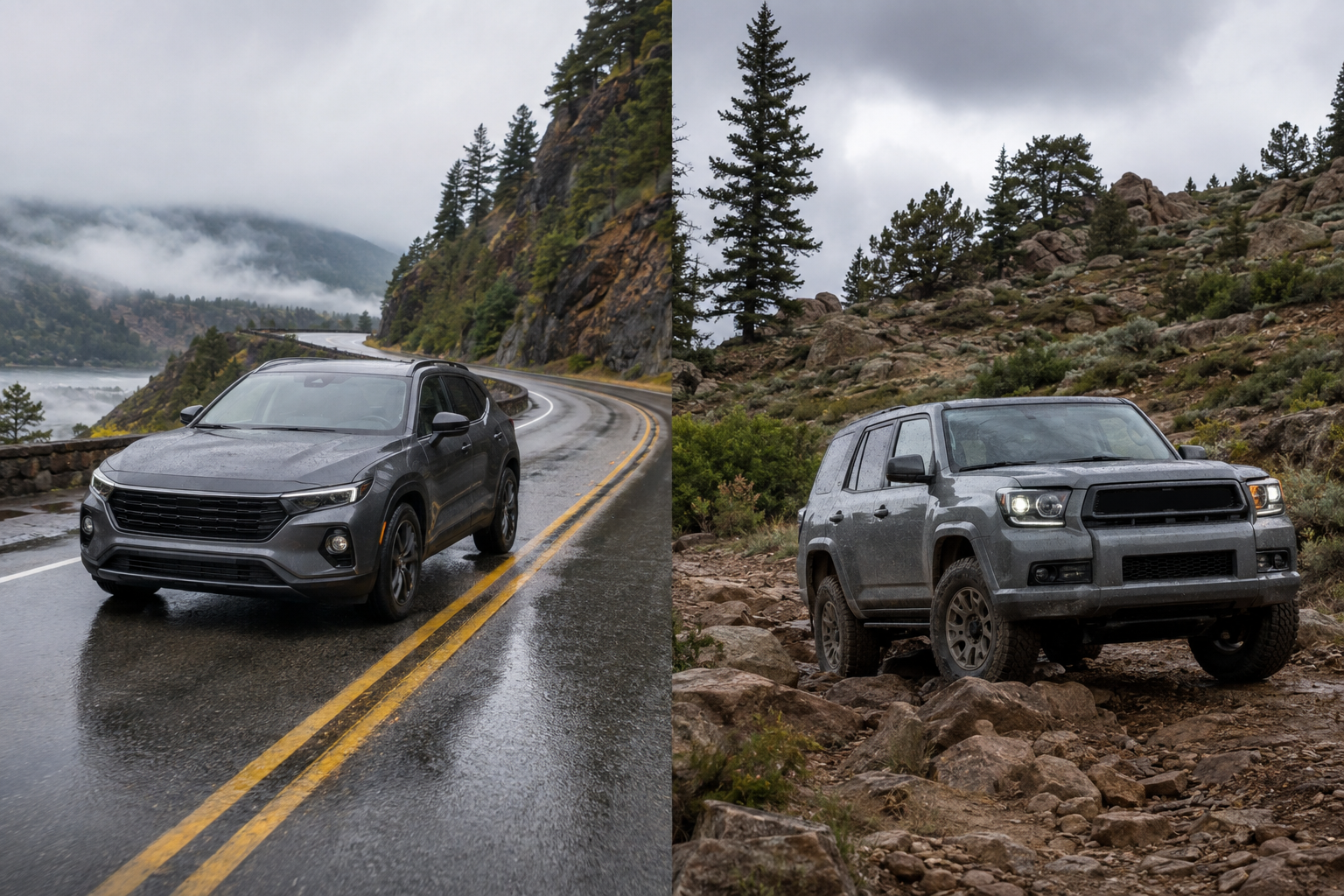
AWD and 4WD are often sold as confidence features, but the right choice is less about confidence and more about context. A commuter who sees winter rain a few times a year has different needs than someone who tows, drives unpaved roads, or lives where snow is routine.
The terms are often used interchangeably in marketing, but they describe different systems with different strengths. Understanding what each one actually does helps you choose based on your roads, your weather, and your driving - not a brochure.
All-Wheel Drive (AWD)
AWD systems send power to all four wheels, but the system manages the distribution automatically. The driver does not select modes or engage a transfer case. The system responds to conditions as they change.
How it typically works:- Power is usually biased toward one axle (front or rear) under normal driving conditions.
- When the system detects slip, it redirects torque to the axle or wheels with more traction.
- The system operates continuously and invisibly - no driver input required.
- Paved roads with variable conditions (rain, light snow, wet leaves).
- Daily commuting where you want added traction without manual intervention.
- Crossovers, sedans, and wagons designed for on-road use.
- Drivers who want a set-and-forget system.
- AWD does not help you stop. Braking distance is determined by tires and braking system, not which wheels receive power.
- Most AWD systems are not designed for sustained off-road use, deep snow, or rock crawling.
- AWD adds weight and complexity, which can slightly reduce fuel economy compared to a two-wheel-drive equivalent.
- The system's effectiveness depends on tire condition. Worn tires reduce the benefit of AWD significantly.
Four-Wheel Drive (4WD)
4WD systems are typically found on trucks and off-road-oriented SUVs. They are designed for low-traction surfaces and often require the driver to select a mode.
How it typically works:- The driver selects between 2WD (two-wheel drive) and 4WD modes, either manually or through a dial or button.
- 4WD High is used for low-traction surfaces at normal speeds (snow, gravel, dirt).
- 4WD Low provides maximum torque at very low speeds for steep inclines, deep mud, or rock crawling.
- Some systems include locking differentials or terrain modes for specific conditions.
- Unpaved roads, trails, and off-road terrain.
- Deep snow, mud, sand, or loose surfaces.
- Towing on uneven or slippery surfaces.
- Vehicles designed for off-road capability (pickup trucks, body-on-frame SUVs).
- 4WD adds weight, complexity, and cost.
- 4WD does not improve fuel economy.
- Using 4WD High on dry pavement can cause drivetrain binding and accelerated wear.
- 4WD does not help you stop. Braking performance is still determined by tires and brakes.
- Some systems require the vehicle to be at a complete stop to shift between modes.
The Real-World Difference
The practical distinction comes down to how the system engages and what it is designed for:
- AWD is automatic, continuous, and designed for on-road variable conditions. The driver does nothing.
- 4WD is often selectable, designed for low-traction surfaces, and may offer low-range capability for extreme conditions.
What Tires and Driving Habits Matter Most
Regardless of whether your vehicle has AWD or 4WD, the single most important factor in traction and control is your tires. A vehicle with excellent tires and two-wheel drive will often outperform a vehicle with AWD or 4WD and worn or inappropriate tires.
- All-season tires work well for most on-road conditions but have limits in deep snow or extreme cold.
- Winter tires provide significantly better traction in cold, snowy, and icy conditions - regardless of which wheels receive power.
- Off-road tires provide better grip on loose surfaces but may ride louder and wear faster on pavement.
What to Confirm in the Owner Manual
The owner manual for the specific vehicle you are considering describes:
- How the AWD or 4WD system operates.
- Whether the system is automatic or selectable.
- What tires are required or recommended.
- Any limitations on use (speed limits for 4WD, dry-pavement restrictions).
- Maintenance requirements for the transfer case, differentials, or power-transfer unit.
Which Fits Your Use
- Mostly paved roads, occasional rain or light snow: AWD may be the simpler all-around choice.
- Towing, unpaved roads, or regular deep snow or off-road use: 4WD with appropriate modes may be more relevant - check the owner manual for the exact system's guidance.
- Both: Choose based on the roads you use, the weather you face, and the vehicle's owner manual.
Related Articles
Hybrid vs. Plug-In Hybrid vs. Electric Vehicle: Which One Fits Your Driving Habits?
Hybrid, plug-in hybrid, or electric? A practical comparison of how each fits daily driving, charging access, and ownership routines - with specific buyer considerations for each.
Why Some Drivers Still Prefer Manual Transmissions
Manual transmissions are no longer the default, but they still appeal to drivers who want more involvement. What that trade-off means day to day, and what to know before choosing a manual.
What to Check Before Buying a Used Car: A Practical Inspection Checklist
A step-by-step used-car inspection checklist covering VIN checks, open recalls, maintenance records, test-drive cues, and when a pre-purchase inspection is worth the cost.